A Critical Analysis of its Negative Effects
.

Colaboradora
Globalization was expected to be a turning point for the discipline of international relations, significantly altering its nature in two crucial ways. The first is the growing interdependence between countries, which has created a greater need for cooperation and coordination in areas like trade, the environment, and security. The second is the emergence of technology that has enabled faster communication and access to real-time information, thus increasing the pace of foreign policy decision-making. This duality has given rise to a new network of global actors, including multinational corporations, NGOs, and local entities, which have expanded the practice of diplomacy in the creation of multilateral agreements to serve specific interests, previously limited to technocratic organizations.
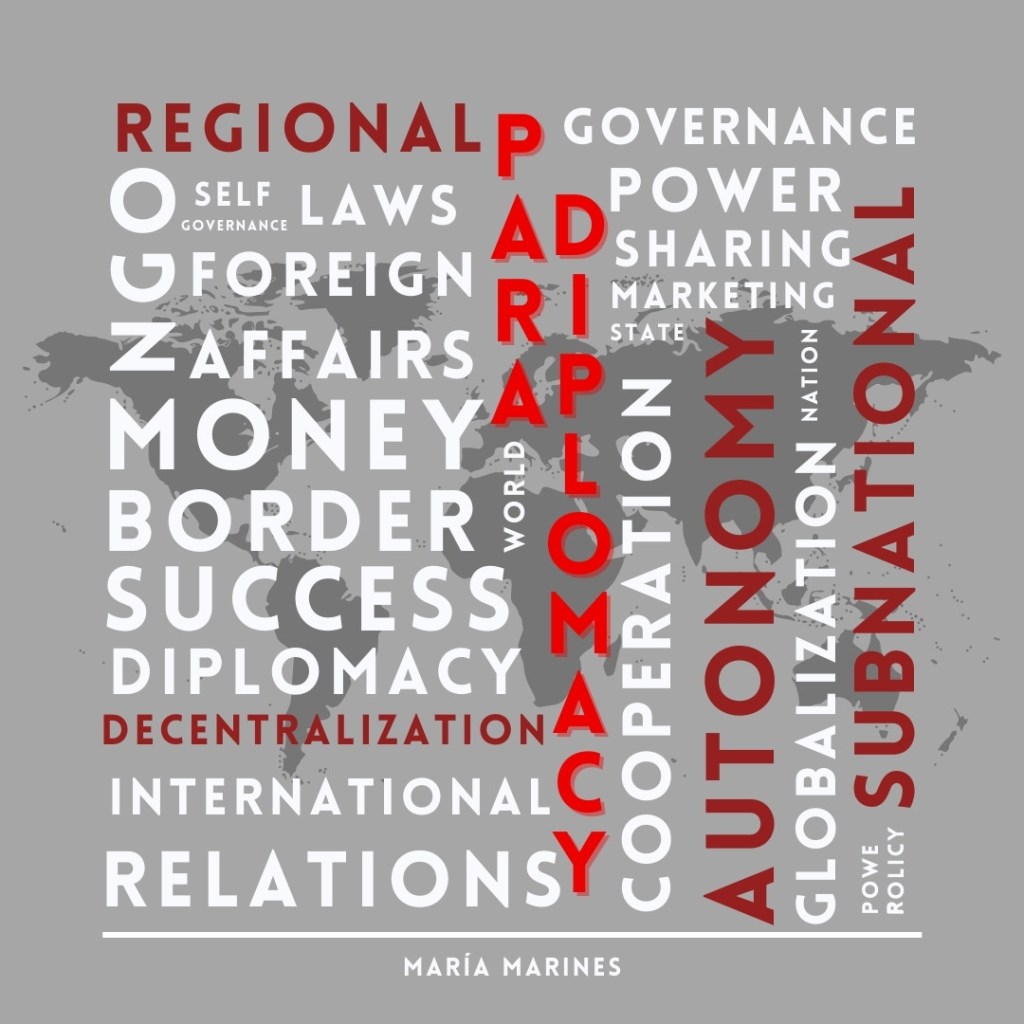
Such diplomatic flexibility has led to variations in its practice, with one of its aspects being paradiplomacy. Initially defined in the 1960s by International Law as an additional mission for local and regional communities to participate in the transnational agenda, the concept was very loose until the 1980s when French political scientist Maurice Caisse defined paradiplomacy as «a set of actions carried out by the regions of a state and directed towards foreign entities, with the aim of defending their interests and promoting their image abroad» (1986). Thus, it became apparent that paradiplomacy, rather than being a complementary activity, is a modus operandi of States, independent of the Federation to which they belong.
In light of the above, paradiplomacy is an important tool for the global projection of regions and cities, as «it allows them to promote their identity and culture, attract foreign investment, and establish strategic alliances with other international entities» (Lever, 2019, p. 112), in response to the lack of attention and representation they receive from the central government.
Some clear examples of success are the state of Bavaria in Germany, which has used paradiplomacy to promote its international image and attract foreign investment through its representative office in China, where it has established commercial relations with oriental companies and organized cultural events to promote Bavarian culture; while the Valencian community, in Spain, used paradiplomacy to organize a commercial mission to the United States in 2019 to promote investment in the locality, resulting in new business contacts and the strengthening of relations with the North American country. Similarly, in Latin America, the city of Guadalajara, in Mexico, found refuge in paradiplomacy to facilitate cross-border cooperation with cities in the United States and Canada, through twinning agreements and joint economic development projects. Even another successful case in Mexico is that of Cancun, which taking advantage of its geographical position and infrastructure to establish international relations and promote its image abroad, as well as participating in international forums such as the World Tourism Summit and signing agreements with cities in other countries, for instance, Miami and Nassau, allowing for the exchange of knowledge and the promotion of tourist destinations in both cities. Lara Pacheco highlights the creation of the Quintana Roo Tourism Promotion Council, which has been fundamental to the development of paradiplomacy in that region (2016).
Indeed, while paradiplomacy allows for the creation of networks of collaboration and alliances between regions, cities, and provinces, which can enhance their global influence, it is important to note that it is a threat to state-centered hegemony. This provides the perfect pretext for the Theory of International Relations to obstruct its execution. Despite the behavioral approaches of paradiplomacy, it has more semblances of separatism than complementary diplomatic activity. Besides, the literature on International Law does not regulate the obligations or privileges of paradiplomatic actors, allowing them to exercise their actions and decisions arbitrarily, risking being considered an intrusion into the field of Foreign Policy, which is constitutionally monopolized by the Federal State.
One of the negative effects of paradiplomacy is the generation of conflicts and tensions between subnational entities and the central government, as well as unfair competition between regions and cities. Those who enjoy greater autonomy and resources can carry out a more effective foreign policy than others, creating state inequality. An example of this is the case of Catalonia in Spain, historically a rich and powerful region capable of pursuing its own foreign policy, unlike less fortunate regions, which is evident in the recent conflict over its search for independence.
Furthermore, paradiplomacy can have a negative impact on coordination between the federal state and subnational entities, and thus on the formulation of a coherent foreign policy. This is because it could generate friction and conflicts between different levels of government, especially in cases where the political agendas of local governments are not aligned with national interests, particularly in terms of international image and negotiating power. For example, in 2018, Mexico was involved in a conflict generated between the Federal Government and the Government of Nuevo León due to the participation of the entity in negotiations for the North American Free Trade Agreement without proper coordination with the central government, causing the Ministry of Foreign Affairs to express concern about the state’s intervention in foreign policy matters.
Subsequently, paradiplomacy represents a challenge to central authority, eroding the cohesion and control of the country, creating an environment of competition and rivalry, not only between subnational entities but also with the federal government. If used locally for electoral purposes, it could lead to the politicization of foreign relations and the adoption of policies that do not reflect the general interests of the country.
Finally, the most evident downside of paradiplomacy is the possibility that subnational entities may conflict with other countries, such as when a region seeks to promote its commercial interests abroad, directly competing with other regions or countries seeking the same, which is likely to generate friction between the involved parties. For example, since Hong Kong became part of China in 1997, it has enjoyed a high degree of autonomy under the principle of «one country, two systems.» However, in recent years, the Special Administrative Region of Hong Kong has become more involved in foreign policy and established relations with other countries without the consent of the Chinese central government.
Conclusively, paradiplomacy can become a fragmenting instrument of the nation-state. It is important to note that this does not ignore the harm caused by centralist dictatorships disguised as «autonomous» federalisms, especially when regionalism such as the European Union, Mercosur, Pacific Alliance, etc. exist, which, like paradiplomacy, aim to defend their interests and improve their position in the global context by being selective about who can enter and who cannot, even if they belong to the same geographic region. From this perspective, it is possible to assert that both ways of proceeding employ unfair marketing to benefit their image with the rest of the world, in contrast or even at the expense of their neighboring countries or states. The difference is that regionalisms enjoy a precise typification in the framework of international law, a legal quality that paradiplomacy lacks and requires immediately for regulated functionality, to avoid scenarios of state, national, and international confrontation.
Regarding paradiplomacy per se, globalization has precisely corroborated that the diversity of identities, even within the same nation, is not synonymous with antagonism, but inclusion. Therefore, the true function of paradiplomacy should be to ensure that various micro-identities can share a macro-identity in terms of culture, religion, values, commerce, customs, and more. This is a first great step towards decentralized cooperation, rather than authoritarian provocation.
References
Bibliographical sources:
- Caisse, M. (1993). La paradiplomacia des Régions en Europe. Presses de Sciences Po.
- Glaab, B. (2019). Paradiplomacy and transnational climate governance: The role of subnational actors in post-Paris climate politics. Environmental Politics, 28(2), 270-290.
- Keating, M. (2019). Paradiplomacy in comparative perspective. In Paradiplomacy in Action (pp. 19-38). Palgrave Macmillan, Cham.
- Lara, R. F. (2016). La paradiplomacia en México. Casos de éxito. Instituto Tecnológico de Estudios Superiores de Monterrey.
- López, A., & Sánchez, M. (2018). Paradiplomacia y conflicto de competencias en México. Revista De Relaciones Internacionales, Estrategia Y Seguridad, 13(2), 153-174.
- Oliveira, F. (2019). Paradiplomacia, conflicto de competencias y cooperación en Brasil. Revista De Estudios Brasileños, (8), 15-32.
- Sánchez, F. (2020). La paradiplomacia en México: Retos y perspectivas. Revista Mexicana de Política Exterior, 119, 53-70.
- Serra, G. (2021). The Impact of Paradiplomacy on Subnational Entities and Central Governments: The Case of Catalonia. Regional & Federal Studies, 31(1), 111-127.
Electronic sources:
- Arreola, J. (2019). Paradiplomacia: ¿Un reto para la política exterior mexicana? Revista de Ciencias Sociales, (28), 71-86.https://goo.su/rx7gc
- Cervelló-Royo, R. (2016). Paradiplomacy in the Spanish political system: The role of the Autonomous Communities in international relations. Perspectives on Federalism, 8(2), E31-E58. https://goo.su/WZt3
.

 Red de Estudios Globales Atlas-Polaris
Deja un comentario